Just sayin’…..

Expressions…we all have our favorites and some are downright annoying after people hear them a zillion times.

Growing up, if I even thought about repeating comments other kids made, much less say them in the presence of my parents or grandmother (who lived with us), the consequences were….unpleasant.  Still, when safely out of their eyesight and away from their uncanny hearing abilities, there were no holds barred on what came out of my mouth.  I was a rebel, saying “damn” in the playground of the parochial school I attended but the guilt of my wicked ways would always send me to the Confessional every Saturday afternoon out of the fear of burning in hell.

The 60’s rolled in along with “groovy” in front of everything; food, clothes, boys, cars…you name it and, if The Mindbenders weren’t on the radio reminding you about love being groovy, Simon and Garfunkel were singing the “The 59th Street Bridge Song (Feelin’ Groovy)”. There was no escape until the 80’s hit and groovy bit the dust only to be taken over by……”funky”.  This word, a slang term for a bad odor,  had actually been around for more than twenty years in the music industry but not considered polite terminology until some time later.

I, for one, become nauseated whenever I hear….”bling”.  Anyone ever having the misfortune to catch just one episode of “Bridezillas” can attest to the fact that most of the classless, foul-mouthed women who shouldn’t be allowed to marry (much less procreate but most already have their children IN their wedding party) are featured on this program.  The only time every word out of their trashy mouths isn’t a cuss-word is when they’re spewing “bling” all over the place.

      
I gotcha “bling“….right here!!

I’m sharing a great website where you can peruse to your hearts content through a compilation of American Slang; it’s set up for easy browsing.

                                                http://www.alphadictionary.com/slang/

A few samples of what you will find…….

Fab! …….(Today, it’s “Fabulous”…my oldest daughter beats this one to death)

Gag me with a spoooooooon!…..( This became a household phrase after Moon Unit Zappa’s “Valley Girl” song)

Gnarly! 

Take a Powder!

Skank!…..(I happen to like this one and still use it often)

Whatever your word, or chosen phrase, is….just remember that saying it repeatedly will ultimately annoy someone like me.  Worse yet, you might incur the wrath of a fellow blogging-friend who writes the most incredible posts; ticking her off is worse than spitting into the wind!

Just sayin’…..

Signature

Too Little Time….

Where has the time gone?


Somehow, during the last 45 years together, my husband and I have managed to raise three children, build a home and struggle through life’s inevitable “ups & downs” with the “downs” still leading.  There’s still a faint glimmer of hope that things will improve but there are days when it’s difficult to find any light at the end of that long, winding tunnel.

“Too Little Time”….our wedding song, the love theme from “The Glenn Miller Story”…I was raised on all that Big Band music.  Actually, it was mandated by my father who didn’t allow me to listen to the Doo Wop of the 50’s or any Rock n’Roll that followed.

Or so he thought…

I played his record game while he was around but when he wasn’t, I listened to the few 45’s that I had hidden away like “My Prayer” by the Platters or “Angel Face” by The Neons.  That one ended up getting broken into shards when I got caught “playing my crappy music” one afternoon.  After that it was back to Artie Shaw, Jimmy Dorsey and whatever else the parental leadership allowed.

Have to admit that I did become fond of Glenn Miller’s music, especially after being dragged to see the 1954 movie made about him; that lovely tune, by Henry Mancini, always stayed in my mind.

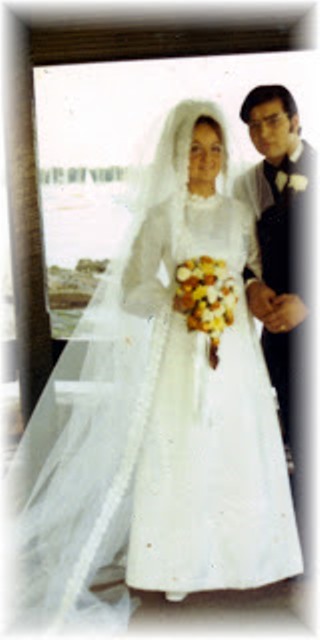
Back in 1970, the wedding song of almost every-one’s choice was “We’ve Only Just Begun” by The Carpenters; it was played to death at wedding after wedding but not at ours.  Somehow, I managed to get a copy of sheet music for “Too Little Time” and it became our song for October 4, 1970 at our small, but elegant wedding reception.


It’s been an interesting ride with two Virgos at the wheel, both being backseat drivers to everything the other one does, but… we’ve managed to survive regardless of  family, and other, turmoil.  Our biggest gifts in life, aside from our kids,  have been our incredible, beautiful, genius grandchildren; there is no better reward that God can bestow on any human being.  They are what makes the endless bumps in life’s road almost non-existent.

Would we do it all again?  Hard to say.  Maybe…John and I would,  if given another chance and the opportunity to do many things differently.  Hopefully, if we manage to survive this dreadful economy and make it through another five years, we might have a 50th Anniversary bash or, like today, just let it pass and be somewhat thankful that we made it this far…. while we both scramble to hold onto time as it speeds past us with a vengeance all its own.


   Happy Anniversary to us!


Signature

Another journey into the dark….

Baby Boomer….People born between (and including) 1946 and 1964.
After American soldiers returned home from World War II in 1946, the United States experienced an explosion of births (hence the name baby boom) that continued for the next 18 years, when the birth rate began to drop.  Today, many of these “boomers” are dealing with the challenges of having to care for their elderly parents who suffer with Dementia-related illnesses.

That…..is what motivated me to write my book as well as this Blog.  At times, recalling everything that involved life with my late mother is overwhelming and I need to post thoughts on events that, I hope,  are light-hearted and bring readers a smile.  Somehow, it always comes full-circle, bringing me back to the subject of Alzheimer’s and care giving.

A close friend called today who has a mother currently hospitalized and ready to be transferred to a nursing facility for twenty-one days of rehabilitation; her Dementia has suddenly taken a rapid turn for the worse.  This woman’s family has known for some time that the mental state of their mother was questionable but she has managed to live by herself with assistance from her nearby sons and their wives.  Still, her behaviors have worsened in recent months and, as in so many families, decisions have to be made regarding her continued, longer term, care.  My friend commented that “it all seems to have moved so fast, her condition worsened almost overnight”.  This is what Alzheimer’s/Dementia does as it progresses through its stages of destruction.

Caregivers reading this have already done a yeoman’s job of research yet there are many families who are just broaching the surface of dealing with Alzheimer’s.  Many have lived with denial, as I did with my Mom, passing so much of what is stated below as some progressive degeneration that goes along with advancing years.  Too many families become so frustrated in trying to do the best for their loved one that they hesitate to question treatment options and administer whatever medications are prescribed.

The conversation I had earlier today with my friend focused on, what I feel, is a horrific drug…Haloperidol (Haldol) which has been prescribed for his mother.  I immediately advised him to refuse the use of this medication.  Why?  Developed back in 1958, this older antipsychotic was initially rejected by Searle Pharmaceuticals due to its side-effects; McNeil Laboratories later started marketing the drug which was finally approved by the FDA in 1967.  Haloperidol is used for the treatment of acute psychotic states and delirium.  Administered to patients diagnosed with neurological disorders such as Schizophrenia or Tourette’s Syndrome, Haloperidol has been rated as 50 times more potent than Thorazine.  In short the side effects of this agent are frightening and can often bring on a stroke, especially in elderly patients.

I have an acquaintance who is the director of a local nursing facility where, at one time, Haloperidol was widely prescribed for end-stage Alzheimer’s patients; the result was, almost always, fatal stroke.  In recent years, this drug has been removed from prescribed medication lists of many nursing homes….but not all.

Knowledge is power, my friends.  Learn all that you can; this will provide you with the background to ask the right questions in caring for your loved one.  Research any and all medications that may be prescribed as they are formulated for generalized treatment;  individual reactions to these compounds vary widely.

I’ve stated before that too many of these drugs butt heads with each other and exacerbate already troublesome symptoms that are present in an AD patient.  Join a support group where a wealth of information and understanding is shared by others; people who have a firm grasp on the reality of being a Caregiver.

Allow me to share some basic information from…. helpguide.org – a comparison on two methods used for staging Alzheimer’s with an overview on the time it may take various stages to run their devastating courses….this is lengthy but informative….

3 Stages of Alzheimer’s disease
Description Duration
Characteristics
Mild/Early
2-4yrs Frequent recent memory loss, particularly of recent conversations and events. Repeated questions, some problems expressing and understanding language.  Writing and using objects become difficult.  Depression and apathy can occur.  Drastic personality changes may accompany functional decline. Need reminders for daily activities, and difficulties with sequencing impact driving early in this stage.
Moderate/Middle 2-10 yrs Can no longer cover up problems.  Pervasive and persistent memory loss impacts life across settings. Rambling speech, unusual reasoning, confusion about current events, time, and place.  Potential to become lost in familiar settings, sleep disturbances, and mood or behavioral symptoms accelerate.  Nearly 80% of patients exhibit emotional and behavioral problems which are aggravated by stress and change. Slowness, rigidity, tremors, and gait problems impact mobility and coordination.  Need structure, reminders, and assistance with activities of daily living.
Severe/Late 1-3+ yrs Confused about past and present. Loss of recognition of familiar people and places.  Generally incapacitated with severe to total loss of verbal skills.  Unable to care for self.  Falls possible and immobility likely. Problems with swallowing, incontinence, and illness. Extreme problems with mood, behavioral problems, hallucinations, and delirium. Patients need total support and care, and often die from infections or pneumonia.

Other Models for understanding Alzheimer’s disease symptoms

Your doctor may also use a diagnostic framework with five, six, or seven levels.  Progression through these stages may last from 8 to 10 years.  Although it is rare, some live nearly 20 years from the time neuron change first occurs.
The seven stage framework includes the following dimensions:

  • Stage 1 – No impairment. Memory and cognitive abilities appear normal.
  • Stage 2 – Minimal Impairment/Normal Forgetfulness. Memory lapses and changes in thinking are rarely detected by friends, family, or medical personnel.  Half of those over 65 begin noticing problems in concentration and word recall.
  • Stage 3 – Early Confusional/Mild Cognitive Impairment.  Subtle difficulties impact functions.  Try to hide problems. Problems with word retrieval, planning, organization, misplacing objects, and forgetting recent learning affect home and work environments.  New learning, complex planning and organization may be impacted. Depression and other mood disturbances can occur.  Duration:  2-7 years.
  • Stage 4 – Late Confusional/Mild Alzheimer’s.  Problems handling finances result from mathematical challenges.  Recent events and conversations are increasingly forgotten.  Still know selves and family, but have problems carrying out sequential tasks, including cooking, driving, and home management tasks.  Ordering food at restaurants, independent shopping, and other sequential tasks are affected. Often withdraw from social situations, become defensive, and deny problems.  Need increasing assistance with the “business” of independent living.  Accurate diagnosis of Alzheimer’s disease possible.  Lasts roughly 2 years.
  • Stage 5 – Early Dementia/Moderate Alzheimer’s disease- Decline is more severe, and requires assistance. No longer able to manage independently in community. Unable to recall personal history details and contact information.  Frequently disoriented to place and or time.  A severe decline in numerical abilities and judgment skills leaves patients vulnerable to scams and at risk from safety issues.  Even if able to dress, feed, and perform other basic daily living tasks, require supervision.  Loss of current information is inconsistent and personal history is no longer reliably recalled.  Duration:  average of 1.5 years.
  • Stage 6 – Middle Dementia/Moderately Severe Alzheimer’s disease- Total lack of awareness of present events and can’t accurately remember the past. Progressively lose ability to dress and bathe independently. Bowel and bladder incontinence often occur, repetitive verbal or nonverbal behaviors are present, wandering, suspicion, and other dramatic personality changes are common.  Can’t remember close family members but know they are familiar.  Agitation and hallucinations are particularly present in the late afternoon or evening.  Late in this stage, need care and supervision but can respond to nonverbal stimuli, and communicate pleasure and pain behaviorally.  Lasts approximately 2.5 years.
  • Stage 7 – Late or Severe Dementia and Failure to Thrive.  Severely limited intellectual ability. Communicate through short words, cries, mumbles or moans.  When speech is lost, also lose ability to ambulate without help.  Health declines considerably as body systems begin to shut down, swallowing is impaired, and the brain is no longer able to interpret sensory input.  Generally bedridden, increased sleeping, seizures possible. No longer responds to environmental cues and requires total support around the clock for all functions of daily living and care.  Duration is impacted by quality of care and average length is 1-2.5 years.

——————————————————————

As with my friend, I’m always happy to share my experiences with the hopes that I can help someone else who has stepped into the role of a Caregiver. 

Thanks for stopping by….

Signature