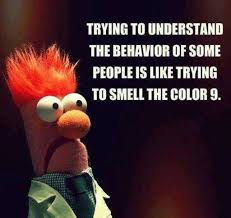
Try, try, again…

I’m going out on a very shaky limb here. Then again, in this day and age, just the simple motion of exhaling can lead to a combative response from someone. “Trying to understand” is a phrase expressing an effort to comprehend something, whether it’s a concept, a situation, or a person’s perspective. It signifies a conscious attempt to grasp the meaning or nature of something, even if it’s not fully or immediately successful.

Sound like a reasonable viewpoint?

My sensibilities are often challenged by those who put their own spin on things and there are times when it’s downright maddening and I cannot understand why. When this takes place, I usually step back to observe and it’s generally in some way which favors the agenda of the person in question. That, in itself, often results in the misinterpretation and exaggeration of the subject at hand. Plus, there are those individuals who move to selectively highlight details in order to fortify their position on a topic. Many of us have more than likely witnessed this when the simple meaning of words become altered, worse yet, twisted. In the meantime, the emphasis is focused just on certain aspects of a given situation while ignoring others.

What often follows is the framing of an event in such a way that it makes it seem more positive or negative than it actually is, such as interpreting an event or situation in a way that aligns with another’s own beliefs or biases. Attention is drawn to certain aspects while minimizing or ignoring others and effectively changing the way a situation is perceived. Euphemisms come into play in order to make something sound less serious, or harsh, or engaging doublespeak to obscure the true meaning. Narratives are built around events or situations, shaping each to fit a desired outcome or to possibly persuade others.

Being human, we all have certain basic needs and one of most basic is the need to understand and be understood. That seldom gets much attention and it should. Without the ability to understand what others say or the meaning behind their words, we can miss important cues, lose out on opportunities, fail to see changes in the so that we can appropriately react and end up going off in a totally different directions. Worse, if we lack understanding, we are more prone to engaging in selfish acts rather than helping others.

As Dale Carnegie once stated, “Any fool can criticize, condemn, and complain but it takes character and self-control to be understanding and forgiving.” Very true. In the meantime, I’d really like to know, to understand, what the color 9 smells like.

From the Writer’s Workshop: What do you wish you understood better? Why?

Signature

Facts or interpretations?

A Chinese saying with somewhat of a debatable hint of being a curse is “May you live in interesting times” which opens yet another discussion as to the statement being an opinion or fact. There is no substantive evidence that this saying was an ancient or modern curse but given the times we currently live in, there’s a bit of interest in the statement as it is personally interpreted. In this day and age, it has become the mission of millions to turn over every rock in researching their need to establish the basis for a fact or opinion.

Interesting times, indeed.


We all know that the facts of any matter are verifiable, that truth is determined by researching any evidence and that sets the stage for differing perspectives on a given situation. Facts are the foundation for providing crucial support for the assertion of an argument. But, facts by themselves are completely worthless unless they are put in context where conclusions can be drawn and meaning is established. With that, speaking up on a particular topic can bring criticism while silence incurs vociferous blame with not speaking out.


Then we have opinions which are judgments based on facts, honest attempts to draw reasonable conclusions from factual evidence. Most opinions are potentially changeable, depending on how the evidence is interpreted. Opinions, by themselves, have little power to convince and it’s important to state necessary evidence which contributed to establishing said opinion. A recent post on social media from someone close stated how often they saw posts and heard folks in real life talk about things that are anecdotal or opinion-based as though they were facts. The post went on to state how it was fine to hear of shared experiences along with any discussion involved but for people to treat said observation as Gospel was simply annoying. I hesitated to share additional commentary well, just because; some things, even those funny as hell, are way better left unsaid


Unlike an opinion, there are beliefs which are convictions based on cultural or personal faith, morality or values. These are viewpoints, not based on facts or other evidence, cannot be disproved or contested in a logical or rational manner.


White it’s important to be able to share an opinion, that does not mean it should always be shared. If someone in your immediate circle is more to the “right” and you are more to the “left”, there is a very strong possibility that there will never be any agreement and there are definitely some topics which should never be discussed. It goes without saying how politics can be very touchy and personal so it is best to stop pushing those around you to agree on everything and just accept a difference of opinion. Friends and especially family won’t always agree with us about our beliefs and opinions and it’s important to retain respect for those around us. It’s fine if no agreement can’t be reached because having different perspectives help people to learn and grow stronger.


Finding common ground can be well, beyond difficult, especially where family is concerned. Different generations bring clashing opinions but when any debate begins, think about what you hope to gain from that interaction. A change of mind or insight into the beliefs of others? Staying both open and respectful creates an important platform for understanding. Respect the human element in the other person’s values and understand that, where political beliefs are concerned, there is a shared concern for society with focus on economic or environmental stability. Taking that step back may help recognize that any “opposing” views may not be wildly different from our own and there is room for agreement.


Mostly, know when to make a necessary exit if emotions run a bit hot and avoid trying to get that last word in, something we are all guilty of doing. Don’t deny it. Just leave it there for that inevitable day when the discussion is bound to resurface and possibly healthier perspectives will emerge, resulting in civil exchanges of opinions and facts.

Sure they will, likely when pigs fly.

Signature